To join together pieces of DNA from different sources, scientists commonly use two types of enzymes: restriction enzymes and DNA ligase.
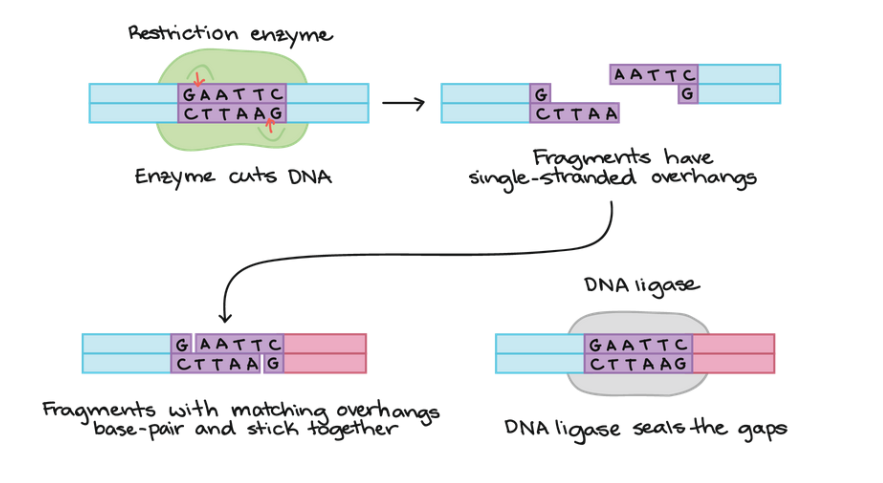
A restriction enzyme is a DNA-cutting enzyme thar recognizes a specific target sequence and cuts DNA into two pieces at or near that site. Many restriction enzymes produce cut ends with short, sing-stranded overhangs. If two molecules have matching overhangs, they can base-pair and stick together. However, they won’t combine to form an unbroken DNA molecule until they are joined by DNA ligase, which seals gaps in the DNA backbone.
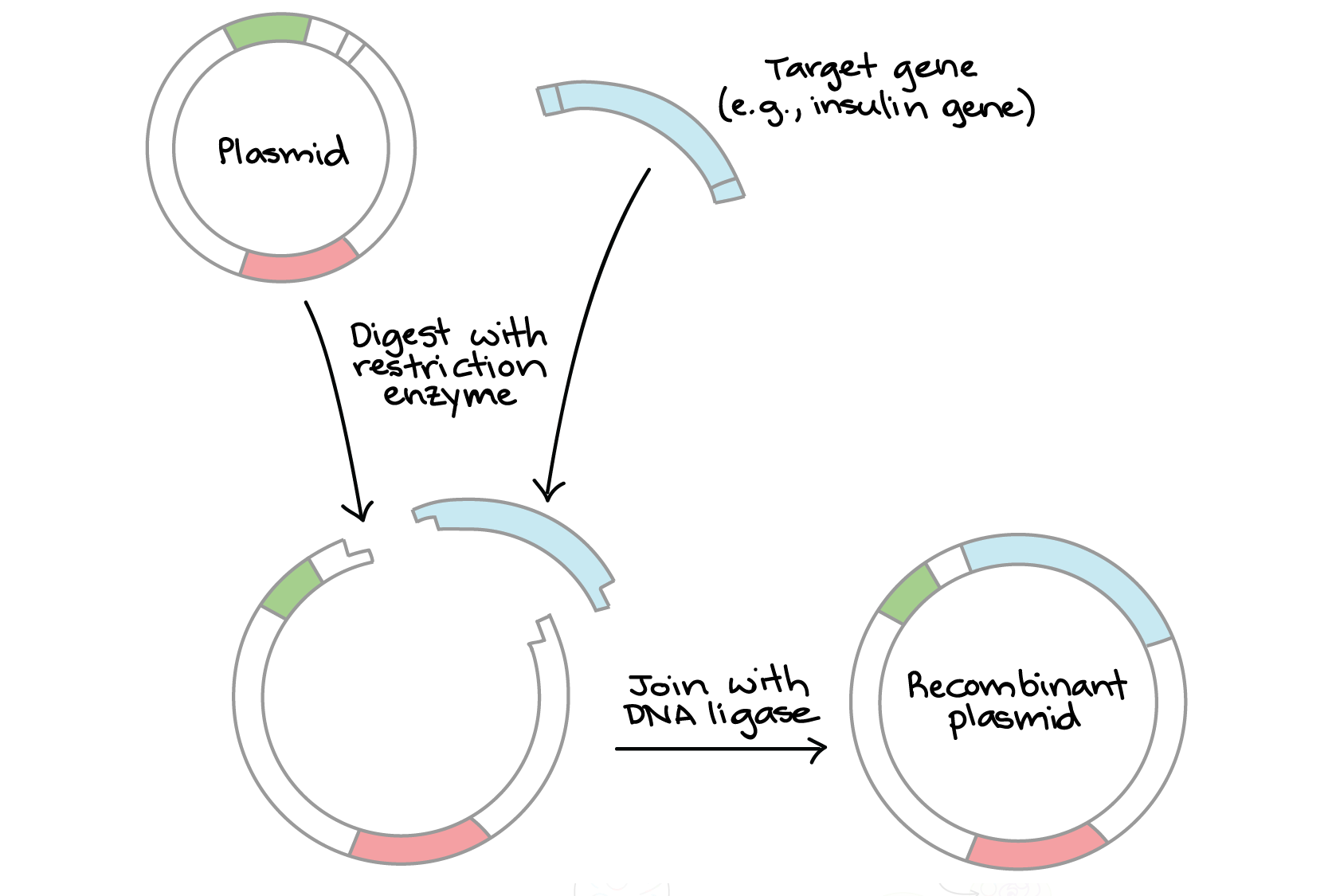
In cloning, the goal is to insert a target gene (e.g., for human insulin) into a plasmid. Using a carefully chosen restrictive enzyme, we digest:
- The plasmid, which has a single cut site
- The target gene fragment, which has a cut site near each end.
Then, we combine the fragments with DNA ligase, which links them to make a recombinant plasmid containing the gene.
The process is followed by transformation.