Key Points
- Charles Darwin was a British naturalist who proposed the theory of biological evolution by natural selection.
- Darwin defined evolution as “descent with modification,” the idea that species change over time, give rise to new species, and share a common ancestor.
- The mechanism that Darwin proposed for evolution is natural selection. Because resources are limited in nature, organisms with heritable traits that favor survival and reproduction will tend to leave more offspring than their peers, causing the traits to increase in frequency over generations.
- Natural selection causes populations to become adapted, or increasingly well-suited, to their environments over time. Natural selection depends on the environment and requires existing heritable variation in a group.
What is evolution?
The basic idea of biological evolution is that populations and species of organisms change over time. Today, when we think of evolution, we are likely to link this idea with one specific person: the British naturalist Charles Darwin.
In the 1850s, Darwin wrote an influential and controversial book called On the Origin of Species. In it, he proposed that species evolve (or, as he put it, undergo “descent with modification”), and that all living things can trace their decent to a common ancestor.
Darwin also suggested a mechanism for evolution: natural selection, in which heritable traits that help organisms survive and reproduce become more common in a population over time.
Evolution
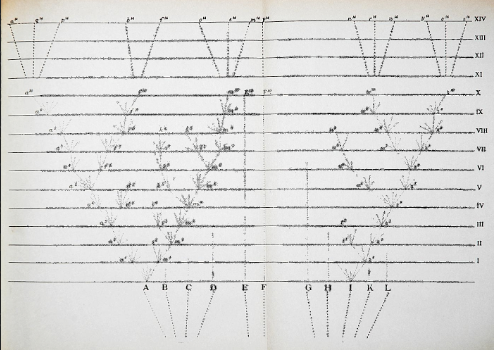
Darwin proposed that species can change over time, that new species come from pre-existing species, and that all species share a common ancestor. In this mode, each species has its own unique set of heritable (genetic) differences from the common ancestor, which have accumulated gradually over very long time periods. Repeating branching events, in which new species split off from a common ancestor, produce a multi-level “tree” that links all living organisms
Darwin referred to this process, in which groups of organisms change in their heritable traits over generations, as “descent with modification.” Today, we call it evolution. Darwin’s sketch below illustrates his idea, showing how one species can branch into two over time, and how this process can repeat multiple times in the “family tree” of a group of related species.
Natural Selection
Importantly, Darwin didn’t just propose that organisms evolved. Instead, Darwin also proposed a mechanism for evolution: natural selection. This mechanism was elegant and logical, and it explained how populations could evolve (undergo descent with modification) in such a way that they become better suited to their environments over time.
Darwin’s concept of natural selection was based on several key observations:
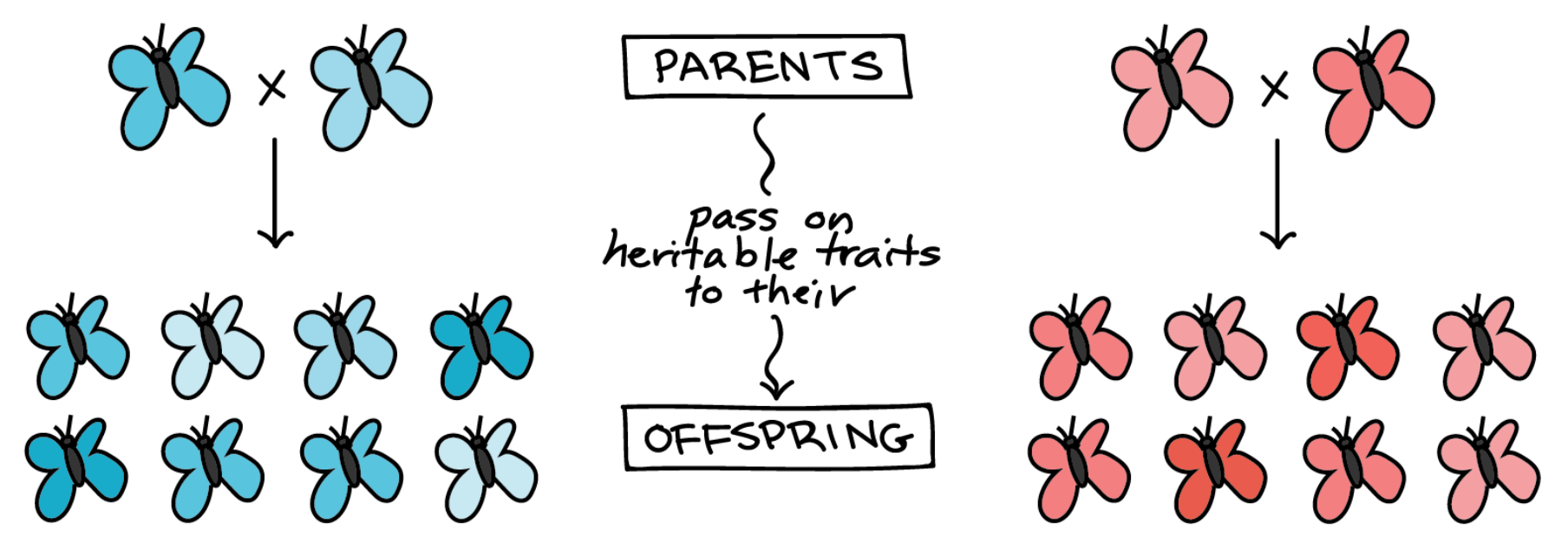
- Traits are often heritable. In living organisms, many characteristics are inherited, or passed from parent to offspring.
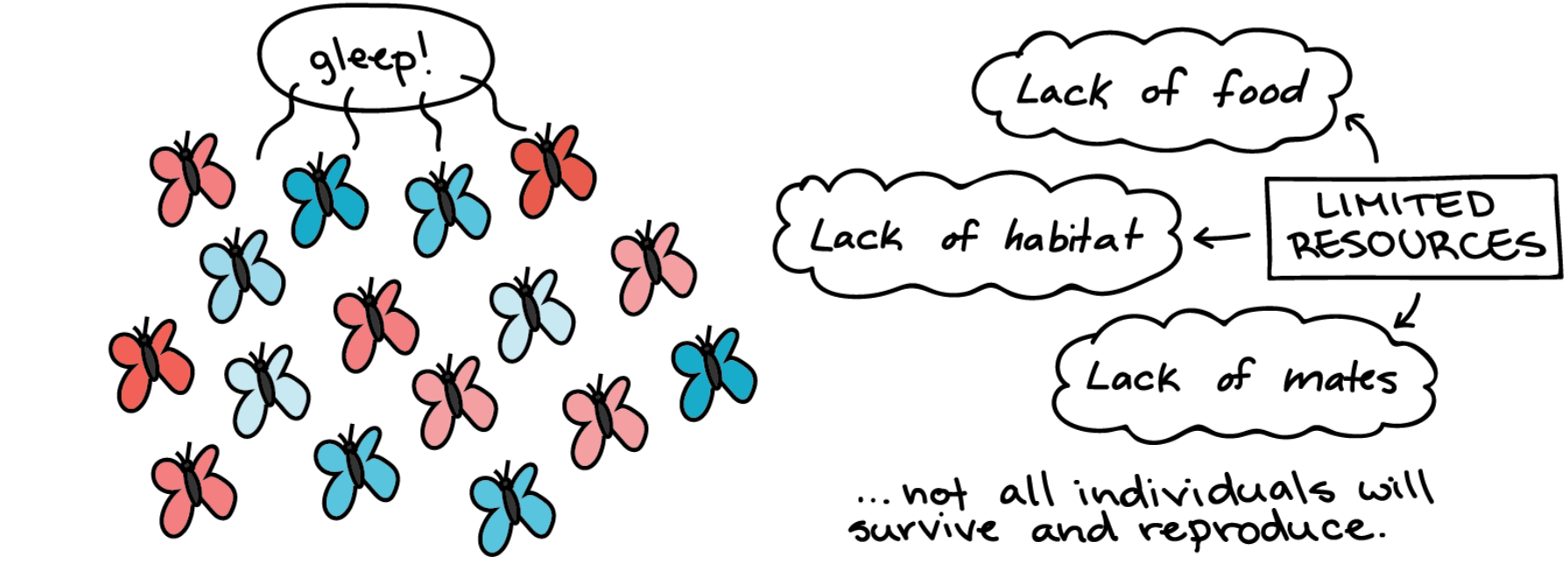
- More offspring are produced than can survive. Organisms are capable of producing more offspring than their environments can support. Thus, there is competition for limited resources in each generation.
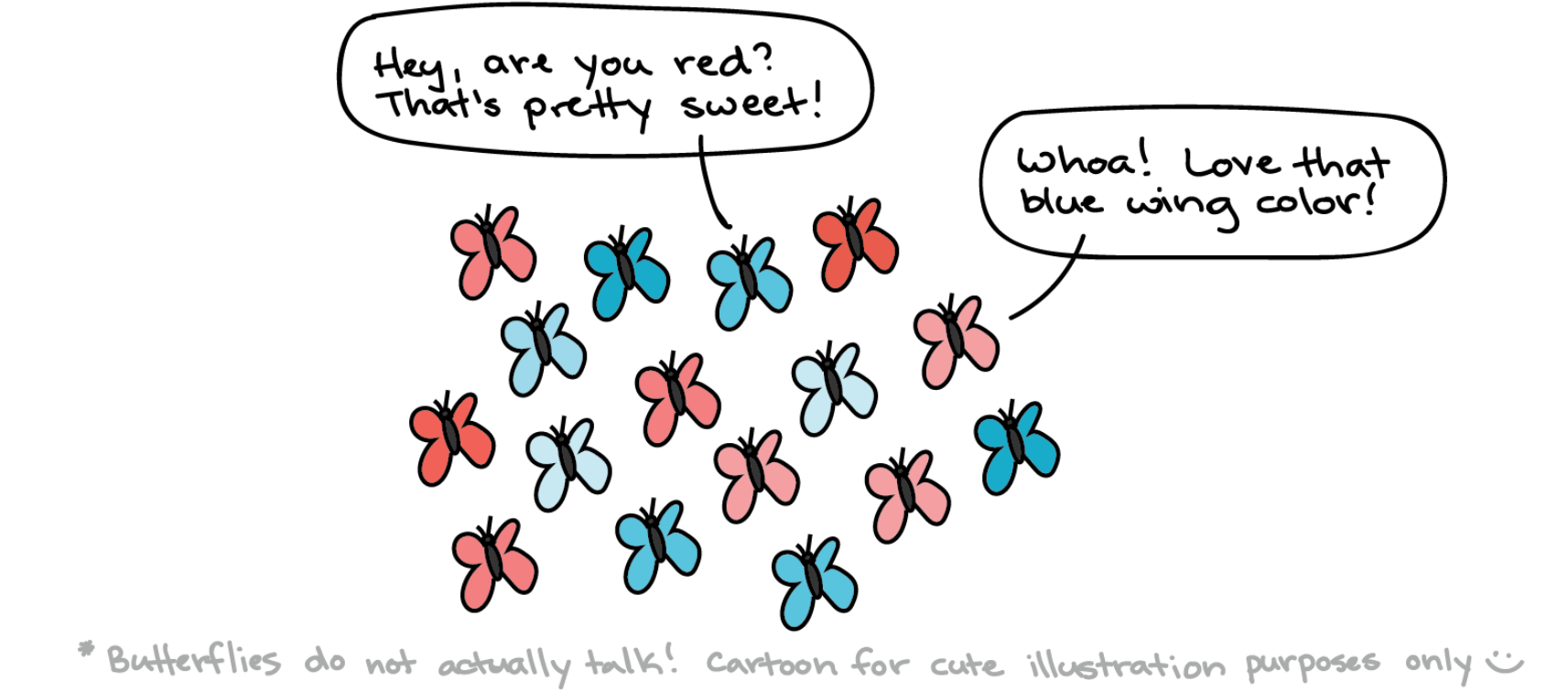
- Offspring vary in their heritable traits. The offspring in any generation will be slightly different from one another in their traits (color, size, shape, etc.), and many of these features will be heritable.
Based on these simple observations, Darwin concluded the following:
- In a population some individuals will have inheritable traits that help them survive and reproduce (given the conditions of the environment, such as the predators and food sources present). The individuals with the helpful traits will leave more offspring in the next generation than their peers, since the traits make them more effective at surviving and reproducing.
- Because the helpful traits are heritable, and because organisms with these traits leave more offspring, the traits will tend to become more common (present in a larger fraction of the population) in the next generation.
- Over generations, the population will become adapted to its environment (as individuals with traits helpful in that environment have consistently greater reproductive success than their peers).
Example: How natural selection can work
Let’s consider a simplified, hypothetical example. In this example, a group of mice with heritable variation in fur color (black vs. tan) has just moved into a new area where the rocks are black. This environment features hawks, which like to eat mice and can see the tan ones more easily than the black ones against the black rock.
Because the hawks can see and catch the tan mice more easily, a relatively large fraction of the tan mice are eaten, while a much smaller fraction of the black mice are eaten. If we look at the ratio of black mice to tan mice in the surviving (“non-eaten”) group, it will be higher than in the starting population.
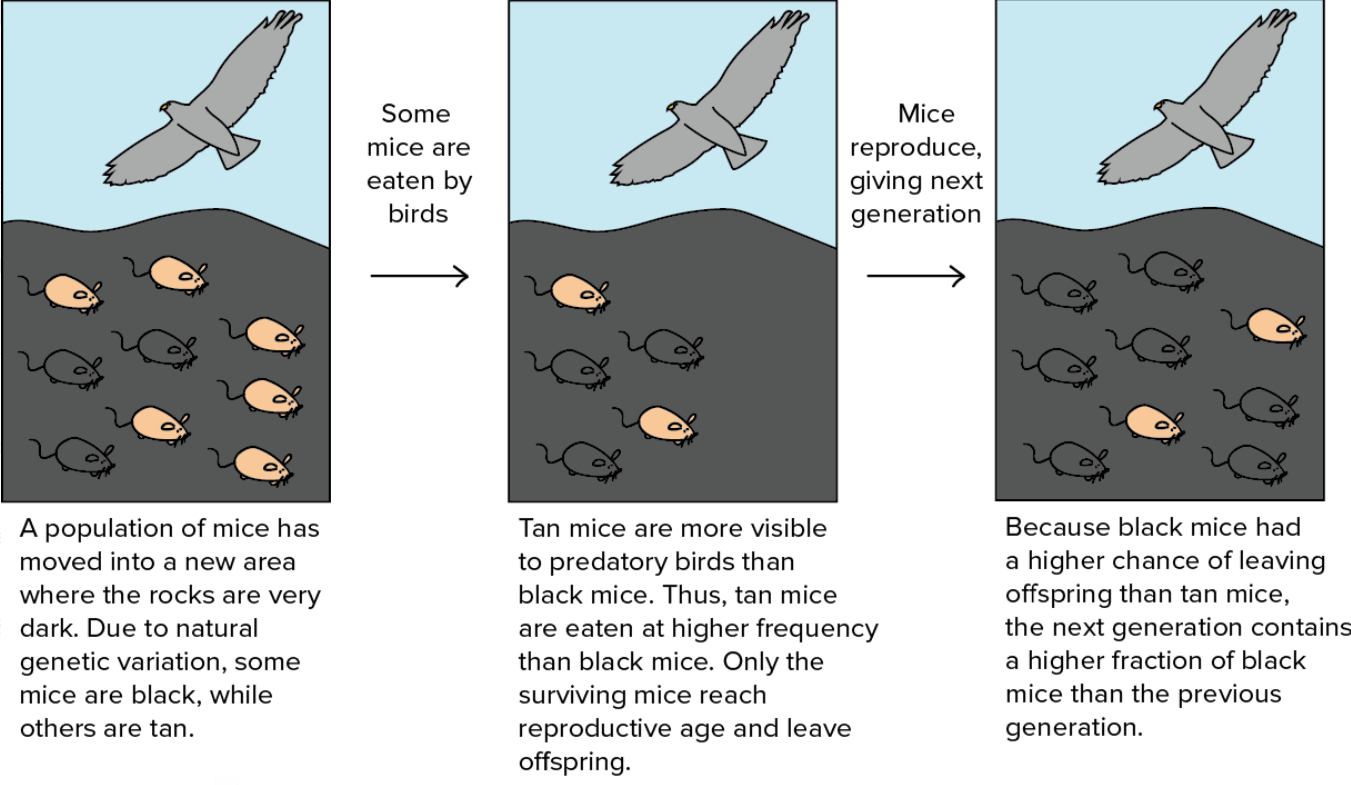
Fur color is a heritable trait (one that can be passed from parent to child). So, the increased fraction of black mice in the surviving group means an increased fraction of black baby mice in the next generation. After several generations of selection, the population might be made up almost entirely of black mice. This change in the heritable features of the population is an example of evolution.
Key Points about Natural Selection
There are many misconceptions regarding natural selection. The following explains clarifies how, when, and why natural selection takes place.
Natural Selection Depends on the Environment
Natural selection doesn’t favor traits that are somehow inherently superior. Instead, it favors traits that are beneficial (that is, help an organism survive and reproduce more effectively than its peers) in a specific environment. Traits that are helpful in one environment might actually be harmful in another.
Natural Selection acts on Existing Heritable Variation
Natural selection needs some starting material, and that starting material is heritable variation. For natural selection to act on a feature, there must already be variation (differences among individuals) for that feature. Also, the differences have to be heritable, determined by the organisms’ genes.
Heritable Variation comes from Random Mutations
The origin source of the new gene variants that produce new heritable traits, such as fur colors, is random mutation (changes in DNA sequence). Random mutations that are passed on to offspring typically occur in the germline, or sperm and egg cell lineage, of organisms. Sexual reproduction “mixes and matches” gene variants to make more variation.