The basic idea of biological evolution is that populations and species of organisms change over time. Today, when we think of evolution, we are likely to link this idea with one specific person: the British naturalist Charles Darwin.
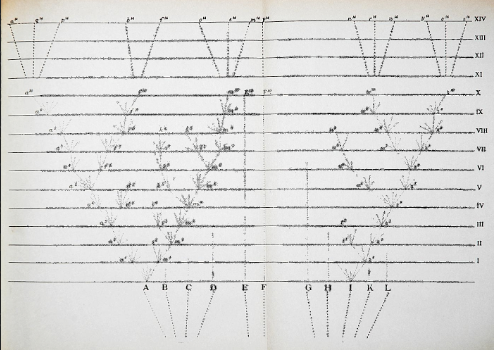
Darwin proposed that species can change over time, that new species come from pre-existing species, and that all species share a common ancestor. In this mode, each species has its own unique set of heritable (genetic) differences from the common ancestor, which have accumulated gradually over very long time periods. Repeating branching events, in which new species split off from a common ancestor, produce a multi-level “tree” that links all living organisms
Darwin referred to this process, in which groups of organisms change in their heritable traits over generations, as “descent with modification.” Today, we call it evolution. Darwin’s sketch below illustrates his idea, showing how one species can branch into two over time, and how this process can repeat multiple times in the “family tree” of a group of related species.